

EBITDA - The Operational Engine: Stripping Away the Financial Noise
This section explains that while net profit is affected by interest loans, specific tax strategies, and accounting choices, EBITDA strips those away. It answers the fundamental question: How well does your factory actually perform based solely on its operational decisions?
Key Outcomes:
- Strip Away the Accounting Noise: Confidently locate and calculate your factory’s true operational earning power using your existing financial statements.
- Link Floor Efficiency to Multiplied Valuation: See exactly how day-to-day wins—like reducing scrap, downtime, and waste—directly multiply your company's total market worth.
- Speak the Language of Investors: Gain the financial fluency needed to navigate high-level conversations with banks, buyers, and board members without feeling out of your depth.
- Navigate the "EBITDA vs. Cash" Trap: Learn how to maximize your operational profit metrics without accidentally draining your real-world cash reserves.
Learn your way.
Each module shares the same core message through video, infographic, podcast, slideshow, and blog post formats. Choose the format that works best for you, then complete the AI-assisted assignment at the end to apply the ideas to your business.
Play Video >
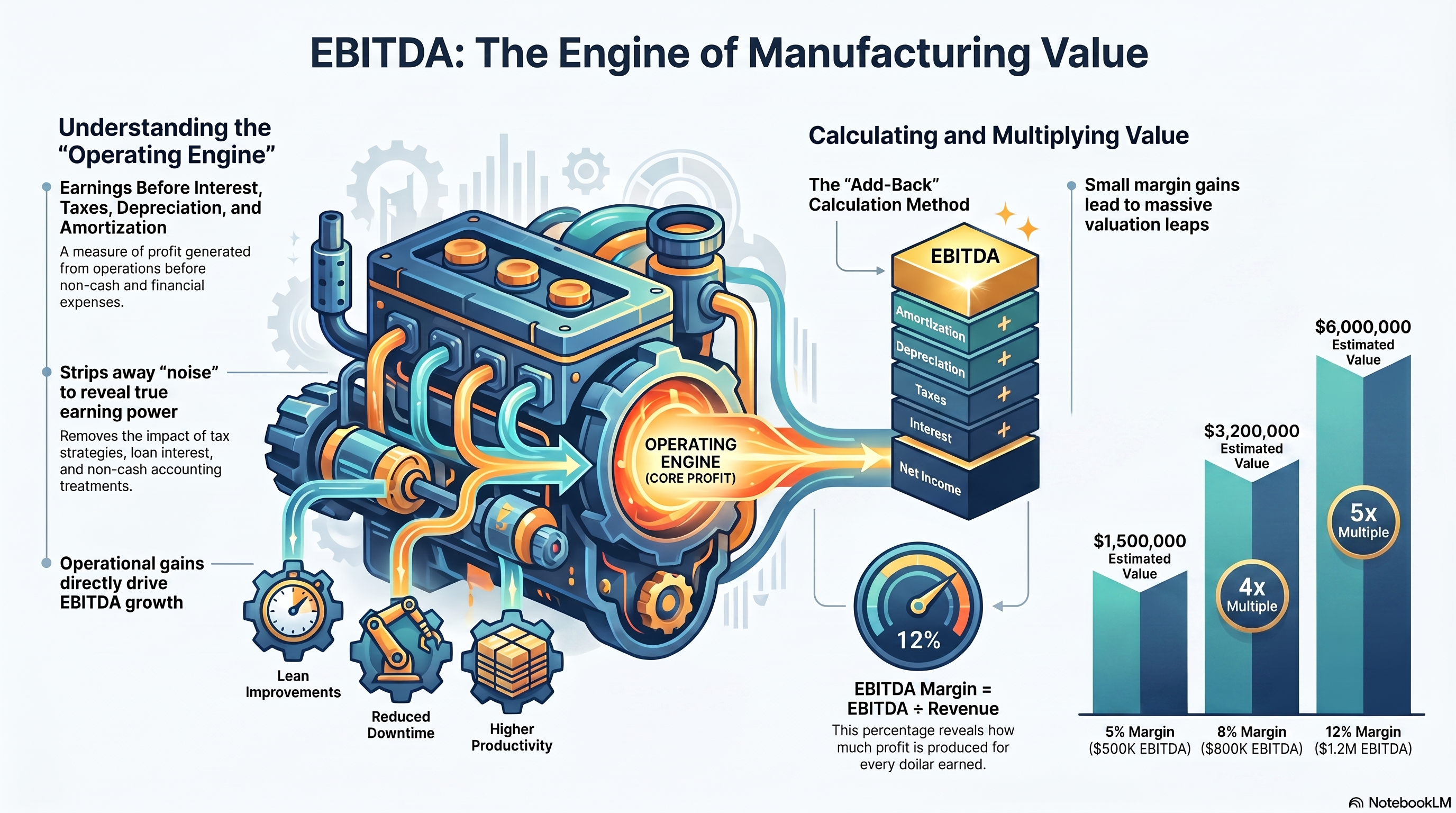
Infographic Overview
Why EBITDA is the Most Important Number in Your Factory (And It’s Not What You Think)
In the high-stakes world of manufacturing, many leadership teams fixate on two primary numbers: top-line revenue and bottom-line net income. While these metrics provide a snapshot of scale and final profit, they often mask the actual health of the manufacturing operation. A company can boast impressive revenue while harboring a dangerously inefficient underlying process, or report a low net income due to tax strategies and debt structures that have nothing to do with the proficiency of the shop floor.
To grasp the true "operating engine" of your business, you must look past the final profit figure. Net income is often a distorted reflection of reality, filtered through the lenses of accounting choices and financing history. To lead strategically, you need a metric that reveals the company’s real earning power by isolating operational performance from financial noise.
That metric is EBITDA. It is the bridge between daily shop-floor improvements and the long-term enterprise value of your organization. By understanding EBITDA, you stop managing toward a static profit goal and start building a high-performance engine capable of compounding wealth.
The Signal in the Noise: Why Net Income Lies
EBITDA stands for Earnings Before Interest, Taxes, Depreciation, and Amortization. In a manufacturing consultant's toolkit, it is the primary instrument used to strip away "financial noise"—variables like interest on loans, aggressive tax strategies, or owner compensation choices that vary wildly from one company to the next.
For an owner or CEO, net income is often a moving target. However, EBITDA answers a fundamental, unvarnished question:
"How well does the business itself perform before we factor in debt, taxes, and accounting treatment of equipment or other assets?"
This cleaner view is vital because it reveals the business's earning power regardless of how it is financed. It also accounts for "one-time or unusual expenses"—such as a singular relocation cost or an atypical repair—that would otherwise unfairly erode the perceived value of your operational success.
The Exponential Power of the Valuation Multiple
EBITDA is more than an internal performance metric; it is the universal language of company valuation. When an investor or buyer evaluates a manufacturing firm, they aren't just looking at profit; they are looking at how reliably the engine produces operating profit. They then apply a "multiple" to that EBITDA number to determine the total value of the company.
Crucially, as your EBITDA margin improves, your business becomes fundamentally "de-risked." A company with a 12% margin is viewed as safer and more efficient than one with a 5% margin, prompting buyers to pay a higher multiple. This creates an exponential effect on wealth:
|
Revenue
|
EBITDA Margin
|
EBITDA
|
Valuation Multiple
|
Estimated Value
|
|---|---|---|---|---|
|
$10,000,000
|
5%
|
$500,000
|
3x
|
$1,500,000
|
|
$10,000,000
|
8%
|
$800,000
|
4x
|
$3,200,000
|
|
$10,000,000
|
12%
|
$1,200,000
|
5x
|
$6,000,000
|
By moving from a 5% margin to a 12% margin, you don't just add 700,000 in profit; you add 4.5 million in enterprise value. Small operational gains are not merely incremental; they are the primary drivers of massive valuation growth.
Floor-to-Exit: Efficiency as a Strategic Valuation Lever
On the shop floor, improvements like "reduced scrap" or "better throughput" are often dismissed as routine maintenance goals. From a strategic perspective, these are actually financial levers. A 1% reduction in material waste doesn’t just save a few dollars on the P&L; it compounds through the valuation multiple, adding hundreds of thousands of dollars to the company’s exit price.
The following operational factors are the direct fuel for EBITDA growth:
- Lean improvements that eliminate non-value-added waste.
- Optimal scheduling to maximize machine utilization.
- Reduced scrap and material yield optimization.
- Minimizing downtime through predictive maintenance and visibility.
- Higher labor productivity and throughput (units out the door per hour).
When a manufacturer invests in AI or advanced operating visibility, they aren't just buying technology. They are executing a valuation strategy. Operational visibility de-risks the business, increases throughput, and directly inflates the EBITDA figure that buyers use to write checks.
The Master Calculation: The "Add-Back" Logic
Calculating EBITDA involves "adding back" specific expenses to your net income to view the business in its purest state. This calculation is a two-part process: achieving "Capital Structure Neutrality" and removing "Non-Cash Accounting Entries."
The Calculation Step-by-Step:
- Start with Net Income: Your final profit after everything has been paid.
- Add back Interest & Taxes: This provides Capital Structure Neutrality. It shows how the business performs regardless of whether you are debt-heavy or debt-free, and regardless of your specific tax jurisdiction.
- Add back Depreciation & Amortization: These are Non-Cash Expenses. They reflect accounting rules regarding how assets lose value over time, rather than actual cash leaving the building to support operations.
- Add back One-time/Unusual Expenses: (e.g., relocation costs or owner compensation choices) to reveal the recurring earning power.
Example Calculation for a $10M Revenue Firm:
- Net Income: $300,000
- Interest Expense: + $75,000
- Taxes: + $50,000
- Depreciation: + $125,000
- Amortization: + $0
- **TOTAL EBITDA: ** $550,000
In this scenario, the "operating engine" is actually producing $550,000—a 5.5% EBITDA margin—which provides a much stronger foundation for valuation than the $300,000 net income suggests.
The Vital Caution: EBITDA is Not Cash
While EBITDA is the ultimate measure of performance and potential, it is not a substitute for cash flow management. A manufacturer can have a "heroic" EBITDA and still go bankrupt if they ignore liquidity.
EBITDA is a measure of potential, but it does not account for:
- Cash tied up in bloated inventory.
- Delayed cash from slow-paying receivables.
- The actual debt payments (principal and interest) that must be paid in cash.
- Major capital expenditures (buying new machines).
EBITDA tells you how much your operation earned; it does not tell you what is in the bank. Working capital management remains the floor that supports your financial ceiling.
Conclusion: The Bridge to the Boardroom
EBITDA is the essential link between the technical efficiency of the factory floor and the financial strategy of the boardroom. It strips away the fog of accounting and financing to reveal the raw power of your manufacturing processes. By focusing on throughput, scrap reduction, and labor productivity, you aren't just running a cleaner shop—you are systematically de-risking your business and compounding its value.
Audit your operations today: If you stripped away your debt, your taxes, and your non-cash accounting, how much power does your "operating engine" truly have—and what is that performance worth to the rest of the world?
Listen to the Podcast While You Work
Why EBITDA Multiplies Your Business Value
19:45
Instructions: For best results and insights, save this assignment image to your device, then upload it to your preferred AI platform. Ask your AI to help you answer the questions in the assignment.
_edited.png?width=1536&height=1024&name=Designer%20(3)_edited.png)



.jpg)