
Improve the System Continually: How AI Turns Pilots into a Learning System
AI creates lasting value when it becomes part of the way your business operates—not a one-time project, dashboard, or software experiment. By using AI to measure what matters, expose weak points, improve workflows, and repeat the cycle, manufacturers can build a faster learning system that strengthens productivity, quality, decision-making, and company value over time.
Key Outcomes
-
Move Beyond One-Time AI Pilots
Learn why isolated AI projects often stall and how to turn promising use cases into repeatable workflows that become part of daily operations, supervisor routines, and management decisions.
Build a Practical Improvement Rhythm
Use a simple cycle—measure, learn, improve, and repeat—to identify what is working, what is breaking, where data is weak, and which workflows deserve more investment.
-
Focus AI on the Four Operating Levers
Evaluate every AI opportunity against the business outcomes that matter most: production flow, labor productivity, quality, and operational decisions.
-
Create a System That Learns Faster
Build the discipline to review AI use cases regularly, refine them with real user feedback, improve the underlying data, and scale only what proves measurable value.
Learn your way.
Each module shares the same core message through video, infographic, podcast, slideshow, and blog post formats. Choose the format that works best for you, then complete the AI-assisted assignment at the end to apply the ideas to your business.
Play Video >
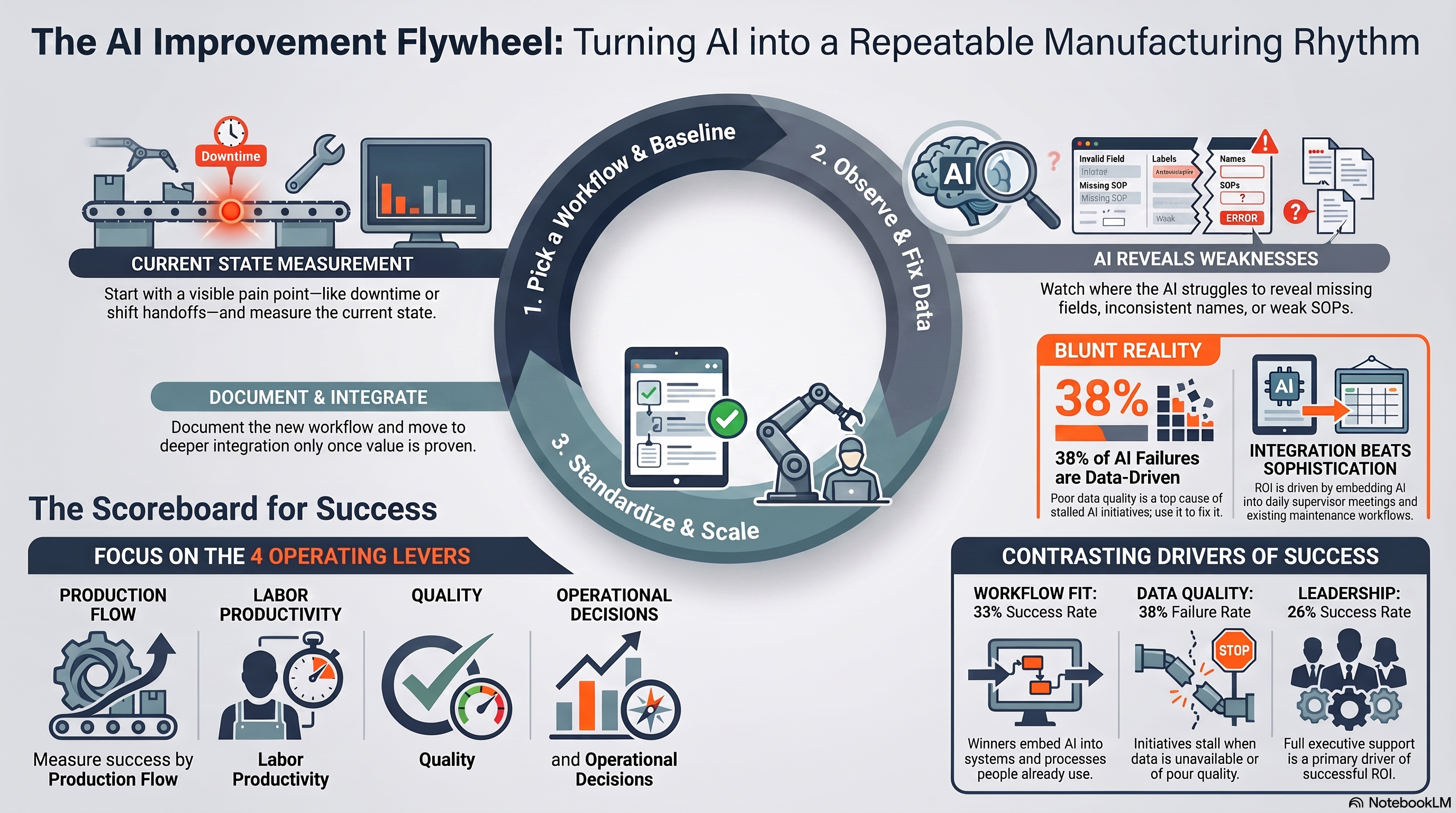
Infographic Overview
Beyond the Pilot: Operationalizing AI into a Continual Improvement Discipline
For many manufacturing executives, the initial excitement of AI has given way to the "AI Stall." You’ve seen the isolated pilots—the flashy dashboards that look great in a demo but fail to scale across the plant floor. This frustration is rarely a failure of the technology itself. Rather, it is the result of the "Project Fallacy": the belief that AI is a one-time software installation rather than a core management discipline.
The strategic reality is that AI value does not come from a single deployment. It compounds when a manufacturer builds a repeatable operating rhythm. To move from "project thinking" to "system thinking," leaders must view AI as an engine for continual improvement—a way to make the entire business learn, adapt, and optimize faster than the competition.
1. AI is a Management Discipline, Not a Software Event
The most resilient manufacturers do not "install" AI; they operationalize it. They treat AI adoption as a leadership rhythm defined by a simple, relentless cycle: ask, measure, learn, improve, and repeat.
While a traditional software deployment focuses on the "go-live" date, a strategic leadership rhythm focuses on how the tool fundamentally alters the business trajectory. If an AI use case is not embedded into the daily SOPs (Standard Operating Procedures) of your supervisors and operators, it is a distraction, not an asset.
The Blunt Reality: Most AI efforts do not fail because the model is not smart enough. They fail because the use case is too broad, the data is not ready, the work is not embedded into daily operations, and leaders treat AI as a side experiment instead of a management system.
2. The "Clean Data First" Fallacy
A primary barrier to AI adoption is the belief that a multi-year data-cleaning project must precede any AI initiative. This is a strategic error that leads to organizational paralysis. The fastest—and most cost-effective—way to improve data quality is to actually use it in a live AI workflow.
AI-assisted workflows act as a diagnostic tool, immediately exposing the systemic constraints in your information flow:
- Missing data fields in the ERP.
- Duplicate part numbers or inconsistent naming conventions.
- Unclear categories that confuse reporting.
- Undocumented "tribal knowledge" that has never been digitized.
By using AI to reveal these weaknesses, you fix your data and your processes simultaneously, turning messy data into a strategic advantage through active use rather than theoretical cleaning.
3. The First Version is a "Test Instrument," Not the Finish Line
In a continual improvement model, the first iteration of an AI workflow is not the final product; its job is to serve as a "test instrument." The goal of version 1.0 is to "observe what breaks" so the organization can identify and mitigate risks before attempting plant-wide integration.
The first version typically reveals four critical areas for improvement:
- Data Gaps: Identifying exactly which records are missing or inaccurate.
- Weak Ownership: Clarifying who is truly responsible for the data and the resulting decision.
- Prompt Refinement: Tuning how humans interact with the AI to ensure high-fidelity outputs.
- Inconsistent Handoffs: Spotting where information is lost between departments (e.g., from Maintenance to Production).
Treating the initial launch as a starting point de-risks the entire project, allowing you to build the foundational trust required for larger-scale deployment.
4. Sophistication is Overrated; Integration is King
According to Gartner, only 28% of AI use cases in infrastructure and operations fully succeed and meet ROI expectations. Success is not driven by the sophistication of the model, but by its integration into the systems people already use—supervisor meetings, maintenance logs, and order planning.
|
Flashy AI Pilots |
High-Value Workflow Integration |
|
Focus on model power and complexity |
Focus on fitting AI into existing daily work |
|
Use cases are too broad to measure |
Use cases are narrow, specific, and measurable |
|
Isolated as a "tech project" |
Embedded in ERP, Teams, or Excel |
|
Often stall after the initial demo |
Built to support supervisors and operators |
5. Use the "Four Levers" as Your Scoreboard
To avoid "pilot purgatory," every AI initiative must be measured against the four operating levers that drive EBITDA and enterprise value. If a use case does not move one of these needles, it is a distraction.
- Production Flow: Improving OEE, reducing bottleneck delays, and increasing throughput.
- Labor Productivity: Reducing supervisor admin hours and accelerating employee ramp time.
- Quality: Slashing scrap rates, rework, and audit findings.
- Operational Decisions: Improving forecast accuracy and inventory turns.
Case Study: The Shift Handoff Improvement Loop. Consider a facility where supervisors traditionally spent 20-30 minutes writing inconsistent, manual handoff notes (the baseline). By implementing an AI-assisted workflow to draft summaries from shift notes, the manufacturer identified that downtime codes were frequently missing. By standardizing those codes and automating the summary, they achieved a 20% reduction in handoff cycle time. This is the "Four Levers" in action: moving from inconsistent tribal knowledge to a disciplined, measurable improvement in production flow.
6. The "Minimum Viable AI Review" is Your Secret Weapon
To maintain discipline, manufacturers must adopt a formal cadence. The "Minimum Viable AI Review" is a targeted session designed to ensure that every use case earns its keep. This meeting rolls up into a Portfolio Mindset, where use cases are scored, prioritized, and—crucially—retired if they do not produce value.
A disciplined review focuses on these six components:
- One Workflow: Keep the discussion focused on a single process.
- One Baseline Metric: Always measure against the "before" state (e.g., Scrap rate or OEE).
- One User Group: Directly engage the operators or supervisors using the tool.
- One Data Weakness: Identify the next systemic constraint to fix.
- One Risk: Monitor security, permissions, and accuracy.
- One Decision: Explicitly decide to scale, improve, or stop.
Conclusion: The Fastest Learning System Wins
The transition to AI is not a race to see who can deploy the most complex model. The winners in the manufacturing sector will be those who build the fastest learning loops. For every $1 invested in generative AI, organizations can realize an average return of $3.70, but that return is not guaranteed. They are earned by companies that treat AI as a discipline, not a project.
By shifting to a "continual improvement discipline," you turn every AI pilot into a way to make your business more disciplined, more visible, and significantly more valuable.
The Strategic Challenge: Which single workflow in your facility is currently causing the most friction, and what would happen if you treated it as a "learning opportunity" to be measured today?
Listen to the Podcast While You Work
Instructions: For best results and insights, save this assignment image to your device, then upload it to your preferred AI platform. Ask your AI to help you answer the questions in the assignment.
-2.png?width=1200&height=799&name=Designer%20(7)-2.png)


.jpg)