
The Productivity Multiplier: Eliminating Drag and Empowering Workers
AI does not replace the manufacturing workforce; it removes administrative friction so people can focus on meaningful work.
Key Outcomes:
-
Identifying the ideal first users, such as supervisors, office staff, HR, sales, quality, and operations managers.
-
Reducing administrative drag, summarizing dense data, and unlocking internal company knowledge.
-
Reallocating saved time toward problem-solving, serving customers, and optimizing operations.
-
Moving from the mindset of "buy software and hope" to actively coaching people to solve daily production challenges.
Learn your way.
Each module shares the same core message through video, infographic, podcast, slideshow, and blog post formats. Choose the format that works best for you, then complete the AI-assisted assignment at the end to apply the ideas to your business.
Play Video >
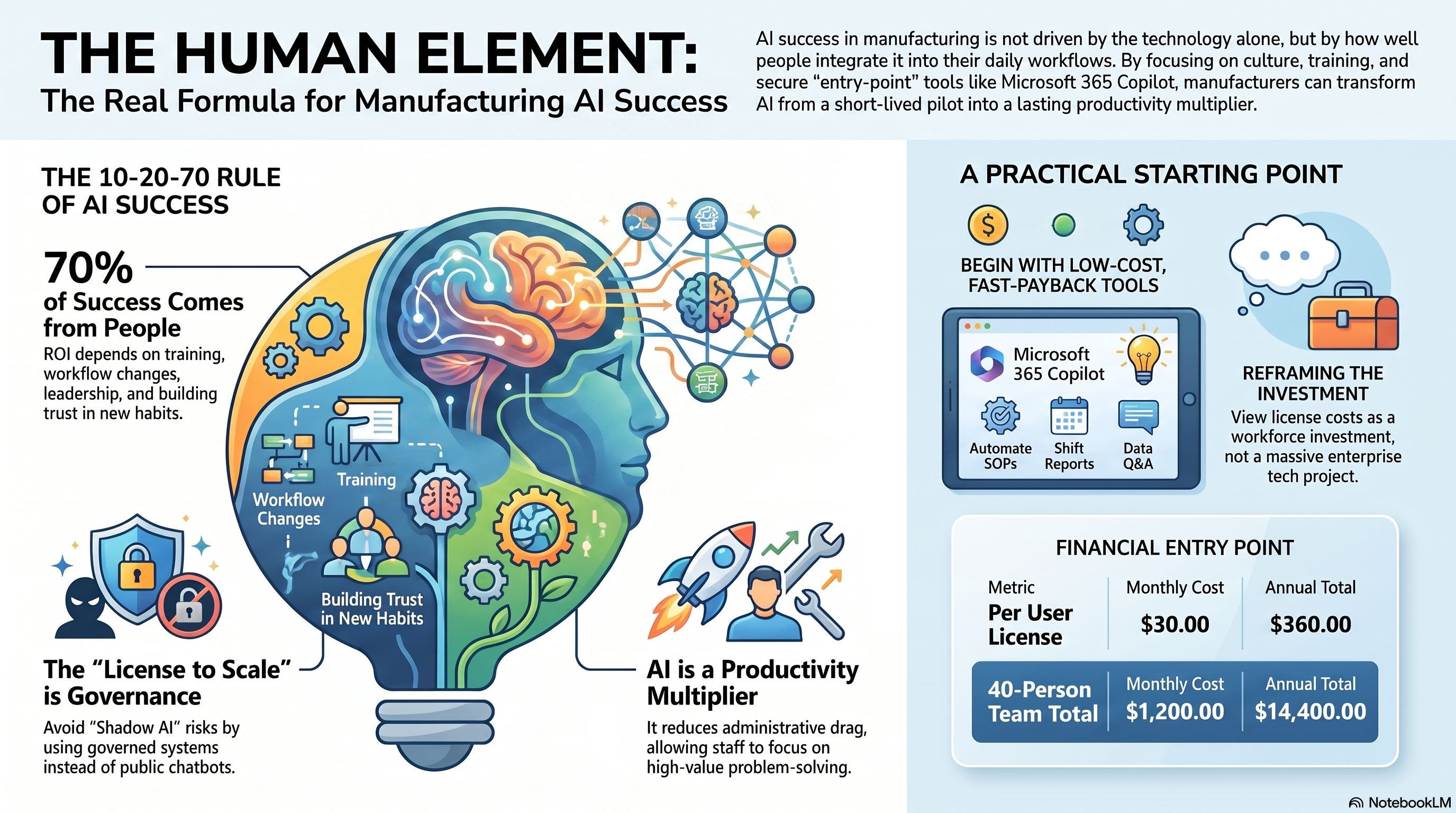
Infographic Overview
Why Your AI Strategy Is Failing (And Why the Solution Isn’t More Software)
The "Shiny Object" Trap
Many manufacturers begin their AI journey with a burst of excitement, launching pilot programs to prove they are at the "cutting edge." However, this initial momentum almost inevitably suffers a "fade out." The energy dissipates not because the technology failed, but because leadership treated AI as a software project rather than a strategy centered on people and operational value.
The transition from a flashy experiment to lasting business value is where most companies stumble. When employees don't see a direct connection between a new AI tool and the friction in their daily tasks, the system becomes an expensive, unused relic. To succeed, we must stop asking what the software can do and start asking how it changes the way work actually gets done.
The 10-20-70 Rule of AI Success
To understand why AI deployments often stall, we must look at the 10-20-70 rule. This framework is the hard truth of digital transformation:
- 10% AI Model: The specific algorithm or software tool.
- 20% Technology and Data Foundation: The infrastructure, security, and data quality required to fuel the model.
- 70% People and Culture: Training, leadership, workflow redesign, and the development of new human habits.
Most organizations spend 90% of their energy and budget on the first 30% of this equation. Why? Because buying software and configuring servers is easy; changing human behavior is difficult. This imbalance is the primary driver of the "fade out." The 70%—the people—is not just a line item for "training"; it is the most critical investment you will make. Without it, you are simply buying tools that no one knows how to use to drive a profit.
"Manufacturers do not win with AI simply because they bought a powerful tool. They win when their people learn how to use AI to improve how work actually gets done."
Stop Chasing Innovation, Start Chasing Value
The goal of AI is not to "look modern"; it is to build a more valuable company through operational discipline. We must distinguish between the "Modernized Company"—which has flashy tools but stagnant margins—and the "Valuable Company," which uses those tools to increase throughput and reduce waste.
AI is not a "magic layer" you can drape over an inefficient process to fix it. It is a tool for continuous improvement. If an AI implementation does not fundamentally change a workflow, remove friction, or improve a specific decision, it has failed to create value. Real profit comes from using AI to capture knowledge and solve problems faster than the competition.
The Danger of "Shadow AI" and the License to Scale
Safety and governance are often viewed as bureaucratic barriers, but in a manufacturing environment, they are your "License to Scale." Today, many companies face a quiet but existential threat: "Shadow AI." This occurs when frustrated or eager employees paste proprietary data into public, ungoverned chatbots to get their work done faster.
When your team uses public tools, you are effectively leaking the crown jewels:
- Protect Your IP: Prevent proprietary product drawings and trade secrets from entering public training models.
- Secure Your Strategy: Ensure customer data and pricing structures remain confidential.
- Defend Your Operations: Keep HR records and internal quality processes within a company-managed system.
A governed environment is not a suggestion; it is a prerequisite. It provides the administrative controls and permissions necessary to give your workforce the tools they need without compromising the business's competitive advantage.
The $30 Entry Point: Starting Small for Fast Payback
Digital transformation does not require a multi-million-dollar capital project. A pragmatic, low-barrier starting point is Microsoft 365 Copilot. For manufacturers already operating within the Microsoft ecosystem, this represents the "lowest cost, fastest payback" path because it utilizes the data and infrastructure you already own.
The financial breakdown for a typical mid-sized manufacturer is remarkably accessible:
- Cost per user: ~$30/month.
- Total Investment: For a 40-person manufacturer, this is roughly $14,400 per year.
Contrast this $14,400 investment with the cost of a new CNC machine or a massive ERP overhaul. This is a workforce investment that provides immediate productivity gains across Teams, Word, and Outlook. By starting here, you provide every worker with the ability to summarize meetings, draft SOPs, and query internal data without needing a team of data scientists.
AI as a Productivity Multiplier, Not a Replacement
There is a pervasive fear that AI is coming for the workforce’s jobs. In reality, AI is a tool to eliminate "administrative drag." In every plant, there are highly skilled people in Quality Control, HR, Scheduling, and Finance who spend hours every day on low-value paperwork.
The goal is a fundamental shift in how these roles function:
- From Drafting to Solving: Instead of spending three hours drafting a quality report, a manager uses AI to summarize findings in seconds, leaving them nearly three hours to actually fix the root cause on the floor.
- From Searching to Planning: Instead of hunting through folders for an SOP, a scheduler uses AI to instantly retrieve knowledge, allowing them to focus on optimizing the production run.
AI doesn't replace the person; it helps the person become more capable by freeing them to focus on solving problems and serving customers.
Conclusion: Culture is the Bottom Line
The technology behind AI is the easy part. The culture of adoption—the 70%—is where the actual profit lies. Manufacturers that treat AI as a mere software purchase will see their efforts stall. Those who treat it as an investment in their people, using it to remove friction and enhance operational discipline, will build a lasting competitive advantage.
"The technology matters, but the culture determines whether AI turns into measurable business value."
As you look at your digital transformation roadmap for the coming year, ask yourself one question: Is your AI budget 70% focused on your people, or is it 100% focused on your software?
Listen to the Podcast While You Work
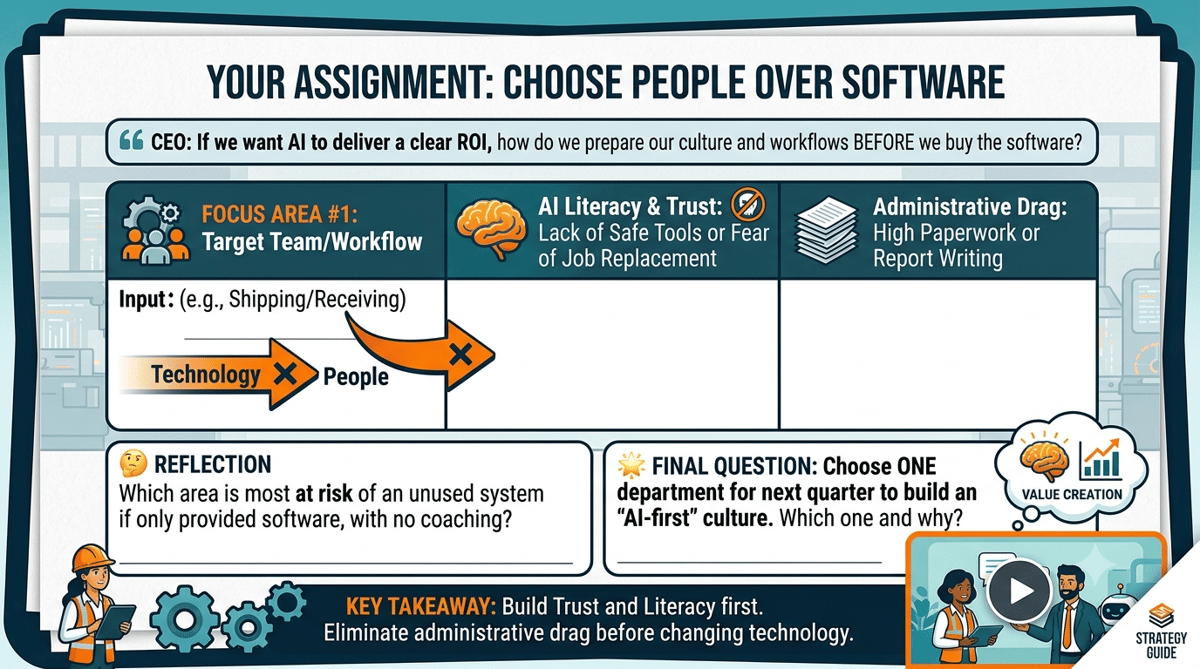
Instructions: For best results and insights, save this assignment image to your device, then upload it to your preferred AI platform. Ask your AI to help you answer the questions in the assignment.


.jpg)