The Unprocessed Ore of Intelligence: Why Your Messy Data is the Fastest Path to AI Leadership
1. The "Clean Data" Myth
Manufacturing leaders are frequently paralyzed by a legacy mindset: the belief that Artificial Intelligence requires a pristine, clinical starting line. This anxiety—that your data is too "messy," too fragmented, or too "human"—has become a significant bottleneck to progress.
As a digital transformation architect, I see this hesitation for what it is: a strategic error. There is a persistent myth that before you can touch AI, you must spend years and millions cleaning records and hiring specialized data scientists. In reality, you don’t need a perfect system to start; you need a shift in architectural mindset. The journey to AI readiness is about visibility, not perfection.
2. Stop Waiting for Perfection—Aim for Visibility
The greatest cost in the race for digital transformation isn't the price of software—it’s the opportunity cost of inaction. While many manufacturers wait for a flawless data environment, their competitors are already using "messy" data to identify bottlenecks.
Waiting for perfection is a strategic failure because it ignores the "Institutionalized Memory" problem. In many shops, the most critical data isn't in a system; it lives in people's heads. The first job of AI is extracting that knowledge into a visible framework. By prioritizing visibility today, you create a feedback loop that "clean" systems cannot replicate.
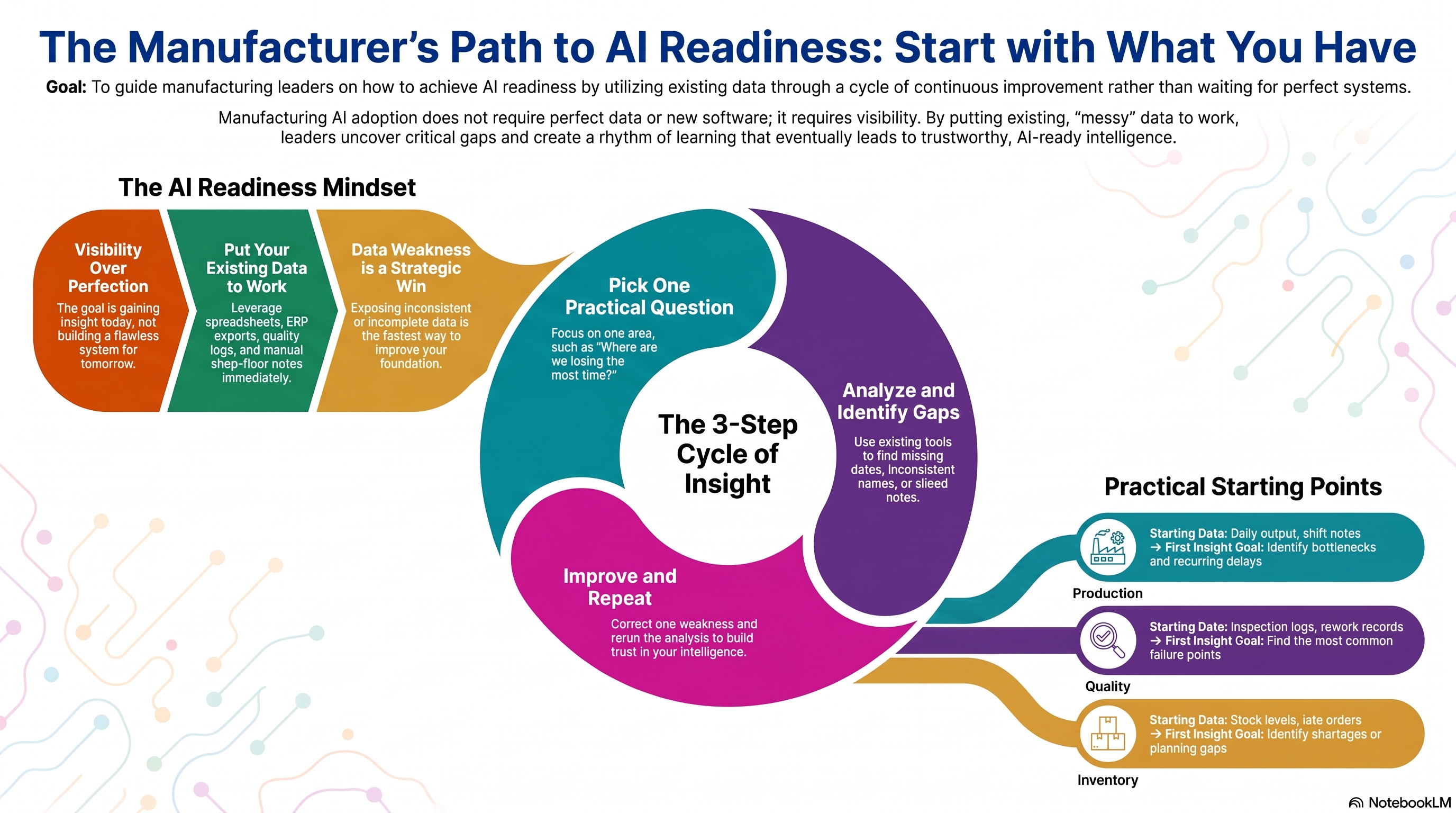
Manufacturers do not need to begin their AI journey by purchasing new software, hiring data scientists, or attempting to build a flawless data system.
3. Why Data Friction Points are Your Roadmap to Profit
In a strategic framework, discovering inconsistent or outdated data is not a failure—it is a high-value discovery. I view these "data friction points" as the unprocessed ore of your future intelligence. The fastest way to improve data is to put it to work.
Common data friction points that serve as roadmaps for improvement include:
- Identity Conflicts: Duplicate customer or vendor names across departments.
- Temporal Gaps: Missing dates in production, shipping, or maintenance logs.
- Standardization Failures: Inconsistent part numbers or vague job categories.
- Operational Silos: Information trapped in one department that never reaches the shop floor.
- The "Head" Gap: Crucial downtime reasons or repair notes that are never digitized.
Putting this "imperfect" data into an AI tool immediately surfaces these gaps, telling you exactly where your business logic is breaking down.
4. The Fact-Based Management Framework
A common mistake is treating the dashboard as the destination. A dashboard is merely a tool for forcing a leadership team to define what actually matters. The real value is the creation of a Fact-Based Management Framework.
Once you move information from "people's heads" into a visual system, AI can summarize and visualize it, allowing leaders to stop managing by intuition and start asking high-stakes questions:
- Are we protecting our margin on every job?
- Where is our throughput actually stalling?
- Are we solving root causes or just reacting to the same rework?
- Are we making decisions based on documented facts or recycled memory?
- Where are our supervisors wasting the most time on administrative paperwork?
5. Start with a "Why," Not a "How"
Don’t ask "How do we use AI?" That is a technical question. Instead, ask a business question: "Where are we losing money, time, or customer confidence?" By narrowing your focus to one practical question and one dataset, you prove value quickly.
|
Business Area
|
Starting Data
|
First Insight Goal
|
|
Production
|
Daily output, downtime, shift notes
|
Identify bottlenecks and recurring delays.
|
|
Quality
|
Inspection logs, rework, complaints
|
Find the most common defects or failure points.
|
|
Labor
|
Schedule data, overtime, shift reports
|
Identify staffing pressures and administrative burdens.
|
|
Sales
|
Quote history, orders, margins
|
Understand which customers or jobs create the most value.
|
|
Maintenance
|
Work orders, repair history
|
Identify repeat equipment problems and root causes.
|
|
Inventory
|
Stock levels, late orders
|
Find shortages or excess inventory planning gaps.
|
6. The 5-Step Rhythm of Learning
AI readiness is a continuous exercise, not a one-time IT project. By adopting this rhythm, you close the loop between data collection and the Fact-Based Management Framework described earlier.
- Pick one question: Focus on a single high-impact business issue.
- Find the data: Gather existing spreadsheets, ERP exports, or even manual shop-floor notes.
- Analyze and Visualize: Use existing tools to summarize and apply your fact-based questions.
- Identify Weaknesses: Note what is missing, untrustworthy, or siloed.
- Improve and Repeat: Fix the source of the friction and run the analysis again.
Analyze what you have. Find the weaknesses. Improve the data. Analyze again. Build better insight. Repeat.
7. Your AI Starter Kit and the Scaling Path
Most manufacturers already own their AI starter kit. If you are in the Microsoft 365 ecosystem, you have Excel, SharePoint, Power BI, and Copilot ready to go. Starting here allows you to prove value without the risk of overbuilding too early.
However, a true Digital Transformation Architect looks at the long-term roadmap. As your data maturity grows, these initial steps lead directly to more robust environments such as Microsoft Fabric or Azure, where you can begin integrating deeper plant-floor data and predictive models.
8. Security: The Foundation of AI Governance
While the potential of AI is vast, it requires an uncompromising stance on governance. You must not paste proprietary recipes, pricing, or customer lists into public AI tools.
Furthermore, there is a hidden internal risk: the oversharing problem. If your internal folders and permissions are messy, AI may surface sensitive information to employees who technically have access but should not. Before deploying AI, your files and permissions must be governed.
Finally, remember that the goal is future-proofing. The modern AI landscape is multi-model (leveraging OpenAI, Anthropic, etc.). By building on a secure enterprise platform like M365, you ensure that you aren't tied to a single technology, but can instead focus on the business value while the platform handles the underlying model evolution.
Conclusion: The Path Forward
AI readiness is the process of turning raw information into organizational trust. It is not about having perfect data today; it is about establishing a culture where data is tested and improved through use. Your "messy" data is not a hurdle—it is the very map you need to navigate toward your next major breakthrough.
What is the one messy dataset in your shop right now that is actually hiding your next big breakthrough?


.png?width=1200&height=799&name=Designer%20(6).png)



.jpg)