Why Most Manufacturers Fail at AI (And the $5 Million Shift That Changes Everything)
The Technology Trap
Many manufacturers today are caught in a cycle of "pilot purgatory." They invest in flashy software demos, vanity metrics, and isolated AI "experiments" that fail to move the needle on the bottom line. This frustration stems from a fundamental strategic error: treating AI as a technology project rather than a company value project.
When AI is treated as a standalone IT goal, it results in scattered efforts that do not materially change the equity value of the business. To succeed, the focus must shift. AI should not be deployed for its own sake; it must be leveraged to improve the "economic engine" of the company. In the eyes of a valuation expert, AI is only as good as the EBITDA it generates and the risk it mitigates.
Takeaway 1: Stop Chasing Tech, Start Chasing EBITDA
The true purpose of AI in a manufacturing environment is to improve the metrics that drive market attractiveness: throughput, quality, labor productivity, and operational risk. Rather than focusing on general "office productivity," high-value AI applications target production flow and frontline decision-making—the areas where the actual money is made or lost.
"AI adoption is a company value project."
By applying AI to these core operational areas, a business makes better decisions faster. This does not just result in a "better-looking" plant; it directly increases Earnings Before Interest, Taxes, Depreciation, and Amortization (EBITDA), which is the primary lever for business valuation.
Takeaway 2: The Double Value Compound (The EBITDA/Multiple Secret)
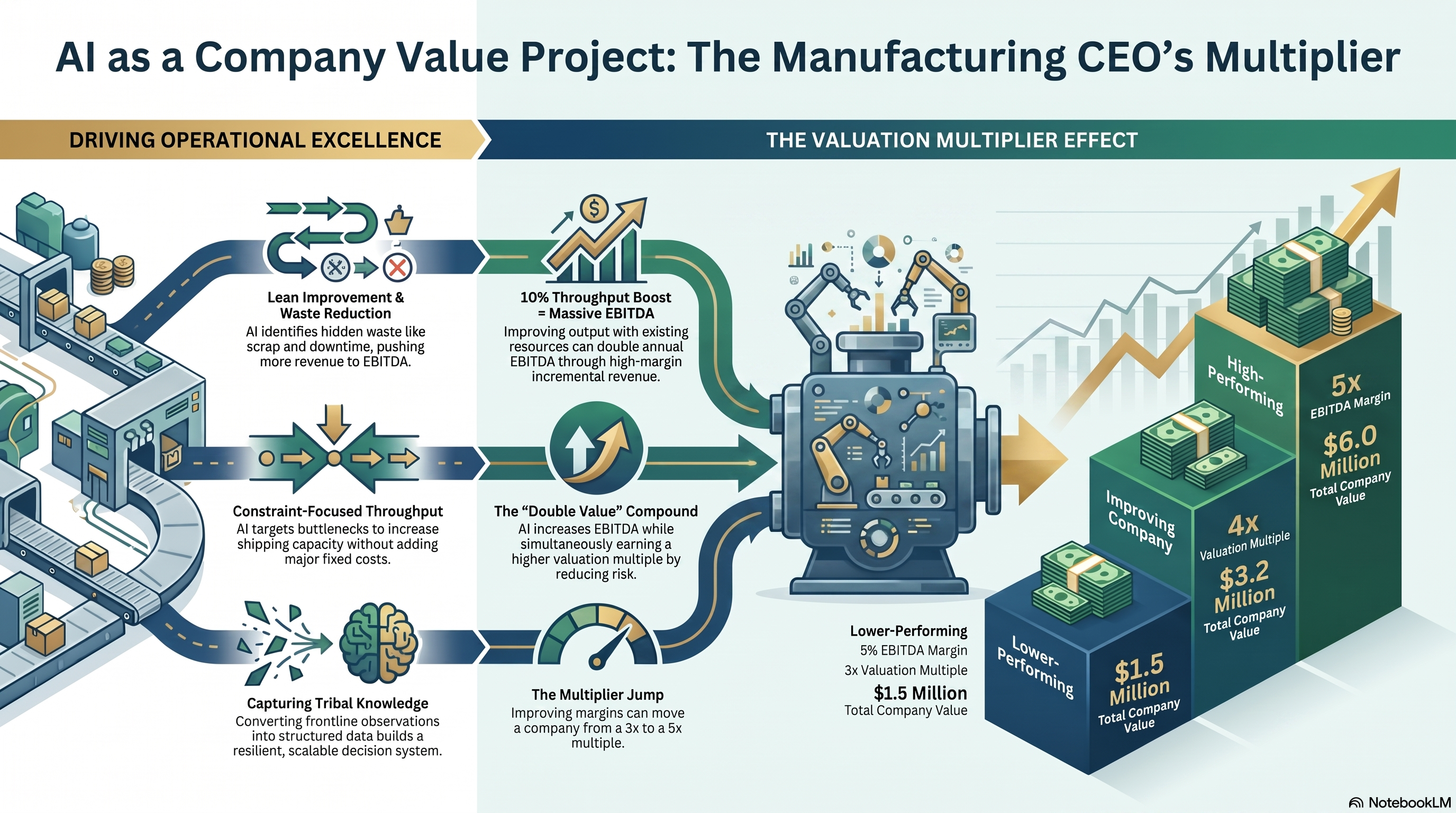
Operational improvements create a compounding effect on company value. When a manufacturer improves its performance through AI-enabled Lean practices, it creates value in two distinct ways:
- Increasing EBITDA: Directly growing the profit generated by the business.
- Increasing the Multiple: Moving the company into a higher "multiple category."
A company moving from a 5% margin to a 9.1% margin shifts from a "risky commodity" profile to a "disciplined, scalable" profile. Buyers and investors pay a premium for systems that are predictable and less reliant on manual oversight. This shift in the character of the business is what justifies moving from a 3x multiple to a 4x or 5x multiple.
Valuation Impact Table
|
Scenario
|
Starting Revenue
|
EBITDA Margin
|
Starting EBITDA
|
Valuation Multiple
|
Starting Company Value
|
EBITDA After 10% Throughput Gain
|
New Company Value
|
Total Value Created
|
|
Lower-performing company
|
$10M
|
5%
|
$500K
|
3x
|
$1.5M
|
$1.0M
|
$3.0M
|
+$1.5M
|
|
High-performing company
|
$10M
|
12%
|
$1.2M
|
5x
|
$6.0M
|
$1.7M
|
$8.5M
|
+$2.5M
|
By moving from a lower-performing operation to a disciplined one, a company doesn't just improve its earnings; it can more than quadruple its total market value, representing a $5 million shift or more for a mid-sized firm.
Takeaway 3: Plugging the "Value Leaks" with Lean AI
Money is constantly "leaking" out of most manufacturing businesses through waste that signals poor management discipline to potential investors. AI-enabled Lean practices allow a company to increase EBITDA without needing to sell a single extra dollar in revenue by plugging these holes:
- Expedited Freight: A margin killer that signals a total lack of operational control.
- Firefighting: Constant reactive management that proves the business is not scalable.
- Duplicate Data Entry: High-impact "invisible" costs that reflect archaic, high-risk systems.
- Excess Scrap and Rework: Direct waste of materials and labor that eats the bottom line.
- Waiting for Decisions: Bottlenecks caused by a lack of real-time operational visibility.
Takeaway 4: The Power of Constraints (The 10% Throughput Rule)
A common mistake is improving areas that are not actually bottlenecks. Improving a non-constraint might make a department look busy, but it does not increase total output. A disciplined, valuation-focused approach asks:
"What is currently limiting the company’s ability to produce and ship more?"
When AI identifies and optimizes the true constraint, the financial impact is immediate because of the Fixed Cost Advantage. In most plants, the core equipment and facility costs are already paid for. Therefore, when throughput increases, roughly 50% of that new revenue drops straight to EBITDA.
For a $10M company, a 10% throughput gain equals $1M in revenue. If $500,000 of that drops to the bottom line, at a 5x multiple, that single operational shift creates $2.5 million in new equity value.
Takeaway 5: Replacing "Tribal Knowledge" with "Operational Memory"
Most manufacturers rely on "tribal knowledge"—the unwritten experience held by veteran operators. From a valuation perspective, this is a massive risk. If your success depends on three veteran managers who might retire next year, your business is worth less.
AI mitigates this risk by capturing frontline data (operator observations, maintenance notes, shift handoffs) and turning it into Operational Memory. This transitions the business from a fragmented "people-dependent" model to a structured "decision-system" model. This systemic replacement of retiring knowledge reduces operational risk and further justifies a higher valuation multiple. The goal is a superior operating rhythm:
- See the problem.
- Understand the cause.
- Prioritize the constraint.
- Take Action.
- Measure the financial impact.
- Repeat.
Conclusion: The CEO’s New Question
AI is not a trend to be chased; it is a strategic tool for building a more valuable, resilient, and scalable company. It allows leaders to stop guessing and start maximizing the capacity of the assets they already own.
To begin this transformation and unlock the dormant equity in your facility, stop asking, "How can we use AI?" and start asking the better question:
"Where are we losing company value, and how can AI help us see it, fix it, and measure the improvement?"
The answer to that question is the key to uncovering millions in untapped equity that is currently hiding on your shop floor.


.png?width=1536&height=1024&name=Designer%20(4).png)



.jpg)